
96 Core Dome Splice Closure – High-Reliability Fiber Optic Protection for FTTx, Backbone & OSP Networks
A 96 core dome splice closure is an essential passive component for modern fiber optic networks, providing a secure, weather-resistant, and highly adaptable enclosure for cable splicing, branching, and distribution. Engineered for outdoor, aerial, duct, and underground installations, this closure ensures long-term stability and low-loss performance in demanding telecom, CATV, and broadband environments. Its robust dome structure maintains internal cleanliness and mechanical protection, making it ideal for FTTx deployment, backbone expansion, and fiber distribution from the central office to MDU and outdoor cabinets.
This product page gives an in-depth look at technical features, applications, installation methods, advantages, and compatibility with related solutions such as fiber optic patch cords, jumpers, PLC splitters, distribution boxes, and patch panels. Whether you are a network integrator, ISP, engineering contractor, or distributor, this is the complete guide to choosing a reliable 96 core dome splice closure.

1. Product Overview
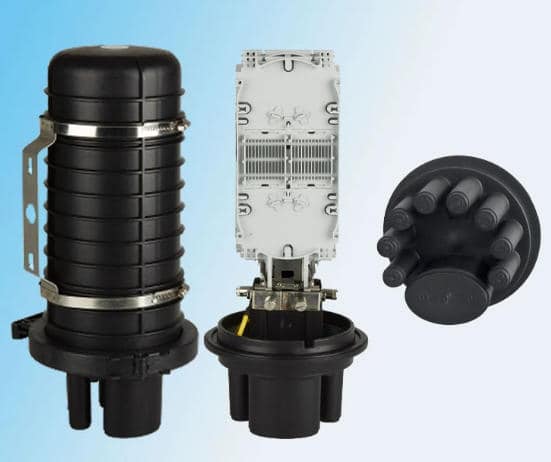
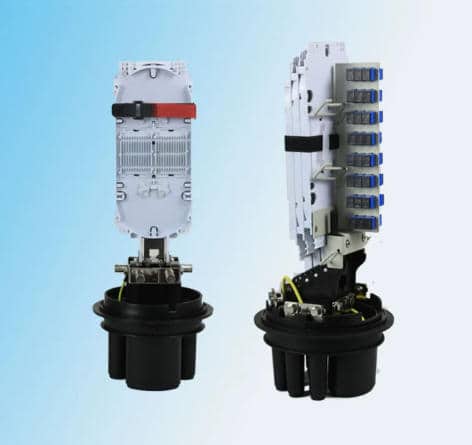
The 96 core dome splice closure supports up to 96 fiber splices through multiple trays arranged in a vertical or modular stacking structure. Its dome-shaped housing provides excellent mechanical strength while the base incorporates multiple cable ports that accommodate different cable diameters. With high-performance sealing mechanisms—typically mechanical sealing or heat-shrink sealing—the closure effectively prevents water ingress, dust contamination, and pressure changes.
Designed to endure harsh outdoor environments, it offers UV resistance, corrosion resistance, and long-term durability. This makes the closure suitable for primary and secondary fiber networks where reliability and protection are required over many years of service.
2. Key Features & Benefits
High Capacity – Up to 96 Fibers
The closure accommodates up to 96 fusion splices using multiple splice trays. This high capacity supports backbone, distribution, and FTTx applications where large fiber counts are required.
Robust Dome Structure
The dome cover provides uniform pressure distribution and ample internal space for routing, splicing, and fiber storage. It withstands mechanical stress, temperature fluctuations, and outdoor exposure.
Excellent Sealing Performance
Equipped with rubber gaskets, mechanical clamps, or heat-shrink sealing options, the closure ensures:
IP68 waterproof rating
Long-lasting weather resistance
Protection against dust, moisture, and liquid intrusion
Flexible Cable Management
The base includes multiple round or oval ports for main and branch cables. It supports:
Loose tube cables
ADSS cables
Figure-8 cables
Ribbon fibers
Drop cables for FTTx
Compatible With Passive Fiber Components
The 96 core dome splice closure works seamlessly with:
Fiber optic patch cords and jumpers for connection to distribution frames
PLC splitters for optical power distribution in FTTx networks
Distribution boxes for subscriber-side fiber management
Patch panels installed in ODF racks or outdoor cabinets
This ensures smooth integration into any OSP or indoor fiber system.
Multiple Installation Options
The closure can be installed:
Aerially using steel straps
On poles using mounting brackets
In manholes, ducts, or underground handholes
On walls or inside cabinets
3. Technical Specifications
Below is a typical specification for a 96 core dome splice closure. Actual values may vary slightly depending on the specific configuration or manufacturer.
| Item | Specification |
|---|---|
| Fiber Capacity | 96 cores (optional: 72/144) |
| Splice Tray Quantity | 4–8 trays depending on design |
| Material | High-strength PP / PC or ABS with UV protection |
| Sealing Method | Mechanical + silicone gasket / Heat-shrink |
| Cable Ports | 3–6 ports (main + branch) |
| Cable Diameter | 8–22 mm (custom options available) |
| Protection Level | IP68 |
| Temperature Range | −40°C to +65°C |
| Tensile Strength | ≥1000N |
| Impact Resistance | IK10 |
| Flame Resistance | V0 (optional) |
| Installation | Aerial, pole-mounted, wall-mounted, duct, underground |
4. Application Scenarios
FTTH / FTTB / FTTC Deployments
The closure is widely used in last-mile fiber networks to splice distribution cables with subscriber drop cables. Combined with PLC splitters, distribution boxes, patch cords, and jumpers, it enables smooth passive network expansion.
Metro and Backbone Optical Networks
Its high capacity and robustness make it suitable for trunk cable management in long-distance transmission lines and metropolitan rings.
Outdoor ISP and Telecom Fiber Projects
Carriers and service providers rely on dome closures to protect spliced joints in outdoor environments such as poles, manholes, towers, and utility tunnels.
CATV and Broadband Networks
Ensures stable signal transmission and low insertion loss for cable TV operators with growing demand for fiber-based services.
Campus and Industrial Fiber Networks
Used in enterprise networks, campuses, factories, and smart city infrastructure for secure, centralized fiber management.
5. Internal Structure & Fiber Routing Advantages
A typical 96 core dome splice closure includes:
Splice Trays
Modular trays provide:
12–24 fusion splices per tray
Clear fiber routing paths
Bend-radius protection
Snap-on covers for dust prevention
Fiber Storage Area
Extra fiber slack can be neatly coiled and secured without stress or microbending, maintaining low attenuation and high transmission quality.
Strength Member Fixation
The closure includes clamps to secure the metallic or non-metallic strength components of the fiber optic cable, enhancing tension resistance.
Cable Port Sealing
Round and oval ports are sealed using rubber gaskets, shrink-able sleeves, or mechanical locks to prevent water ingress and maintain air tightness.
These structural features ensure:
Easy fiber access for maintenance
Efficient splicing and testing
Stable long-term network operation
6. Compatibility With Other Fiber Management Products
A complete fiber network requires multiple passive components working together. The 96 core dome splice closure integrates perfectly with several commonly used products:
Fiber Optic Patch Cords & Jumpers
Used for interconnection from splice closure to distribution box or patch panel.
PLC Splitters
When optical power distribution is needed, the closure can house or connect to:
1×8, 1×16, 1×32 PLC splitters
Mini-module or tube-type splitters
This enables signal distribution to multiple users in FTTH networks.
Distribution Boxes
Often installed after the splice closure to facilitate:
Subscriber drop cable management
Quick connection using SC/APC or SC/UPC adapters
Testing and maintenance operations
Patch Panels
In central offices or data centers, patch panels terminate the fibers that originate from closures, enabling organized fiber management and flexible cross-connection.
7. Advantages Over Dome Splice Closures
While both closure types serve similar functions, the dome design offers distinct benefits:
✔ Larger Internal Capacity
Accommodates more splice trays in a vertical configuration.
✔ Better Sealing Performance
The round, domed housing ensures uniform pressure distribution.
✔ Easier Cable Expansion
Multiple ports support future branching or network upgrades.
✔ Excellent Outdoor Durability
Highly resistant to UV, extreme temperature, and water exposure.
This makes the 96 core dome splice closure a preferred choice for high-density, long-term optical networks.
8. Installation Guide
The 96 core dome splice closure is designed for quick installation with standard fiber tools. A typical installation procedure includes:
Cable Preparation
Strip cable sheath
Clean strength members
Prepare loose tubes and fibers
Fixing the Cable
Secure strength member to the fixture
Fasten fiber tubes inside the tray area
Splicing the Fibers
Use a fusion splicer
Arrange fibers neatly into trays
Fiber Storage
Coil excess fiber
Apply tray covers
Sealing the Closure
Tighten mechanical clamps or apply heat-shrink sleeves
Ensure all ports are sealed
Mounting
Install aerially, on pole, wall, or inside a manhole
The closure allows easy re-entry for future testing, troubleshooting, and fiber rearrangement.
9. Why Choose Our 96 Core Dome Splice Closure?
High Reliability for Long-Term OSP Use
Manufactured with premium materials, the closure maintains structural integrity even in challenging conditions such as high humidity, salt spray, or extreme temperature fluctuations.
Low Insertion Loss & Excellent Fiber Protection
Ensures stable transmission and minimal signal attenuation—critical for 5G, FTTx, and high-bandwidth applications.
Flexible Configuration
Supports various network topologies including:
Point-to-point
Ring networks
Tree networks
Distributed architectures using PLC splitters
Cost-Effective Solution for Large-Scale Deployments
Bulk production and standardized design offer competitive pricing without compromising quality.
Custom Options Available
We offer customization for:
Port size
Tray quantity
Material
Sealing method
Cable diameter compatibility
10. Typical Use in FTTx Projects
A standard FTTH scenario involves:
Trunk fiber from central office arrives at the closure.
Splicing in the 96 core dome closure distributes fibers.
The network branches out through PLC splitters, distribution boxes, and patch panels.
Fiber optic patch cords and jumpers connect customer terminals.
This structured approach ensures stable, scalable, and easily manageable fiber networks.
11. Ordering Information
To ensure you receive the correct configuration, please provide:
Required fiber capacity (e.g., 96 cores, 72 cores, 144 cores)
Cable port quantity & diameter
Sealing type (mechanical / heat-shrink)
Installation method (pole, wall, duct, aerial)
Accessories required (trays, protection sleeves, mounting kits)
OEM and ODM services are available for project-specific requirements.
12. Conclusion
A 96 core dome splice closure is a critical component for building reliable, long-life fiber optic networks. With excellent environmental protection, high fiber capacity, and compatibility with essential devices like patch cords, jumpers, PLC splitters, distribution boxes, and patch panels, it delivers exceptional performance in both backbone and access-level deployments.
Whether you are upgrading an existing system or designing a new FTTx infrastructure, this closure ensures secure fiber management, scalability, and long-term network efficiency.
If you need a product brochure, pricing, EXW/FOB quotation, or customized specifications, feel free to ask!