
Why Telecom Operators Prefer G.657.B3 Fiber Patch Cords and Pigtails
As global telecom networks continue to evolve toward 5G, FTTH, FTTx, cloud computing, and edge data centers, network operators face increasing demands for higher bandwidth, lower latency, and more efficient fiber management. One component that has become increasingly popular is the G.657.B3 fiber optic patch cord and pigtail.
Compared with traditional G.652.D and even G.657.A1/A2 fibers, G.657.B3 offers exceptional bend resistance while maintaining excellent optical performance. This allows telecom companies to install fiber in increasingly compact environments without sacrificing network reliability.
In this article, we’ll explain why telecom companies prefer G.657.B3 patch cords and pigtails, compare them with other fiber types, and discuss their applications in modern optical communication systems.
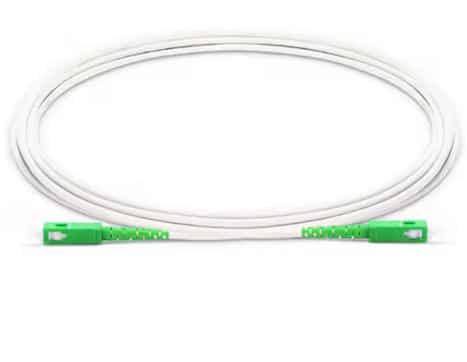
What Is G.657.B3 Fiber?
G.657.B3 is an ITU-T standardized bend-insensitive single-mode fiber specifically designed for applications requiring extremely small bend radii.
Compared with conventional single-mode fiber, G.657.B3 can withstand tight bends with significantly lower signal attenuation.
Typical characteristics include:
- Ultra-low macro-bending loss
- Minimum bend radius as small as 5 mm
- Excellent mechanical durability
- Compatible with 1310 nm and 1550 nm transmission
- Optimized for high-density fiber routing
These properties make G.657.B3 an ideal choice for today’s increasingly compact telecom infrastructure.
Why Bend Resistance Matters
Traditional optical fibers experience increased attenuation whenever the cable is bent beyond its recommended radius.
In real telecom deployments, fiber cables are often installed:
- Inside compact ODF cabinets
- Fiber distribution boxes
- Fiber patch panels
- Indoor wall outlets
- Base station equipment
- Network cabinets
- Building risers
Sharp bends can result in:
- Signal loss
- Higher insertion loss
- Reduced network stability
- Increased maintenance costs
G.657.B3 dramatically minimizes these problems.
Advantages of G.657.B3 Patch Cords and Pigtails
1. Outstanding Bend Performance
The biggest advantage is its superior bend immunity.
Typical bend radius:
| Fiber Type | Minimum Bend Radius |
|---|---|
| G.652.D | 30 mm |
| G.657.A1 | 10 mm |
| G.657.A2 | 7.5 mm |
| G.657.B3 | 5 mm |
Telecom installers can route cables through extremely tight spaces without worrying about excessive attenuation.
2. Lower Optical Loss
Even after multiple bends, G.657.B3 maintains stable optical transmission.
Benefits include:
- Lower insertion loss
- Reduced return loss variation
- Stable network performance
- Improved signal integrity
This is especially important in high-speed optical networks operating at:
- 10G
- 25G
- 40G
- 100G
- 400G
3. Perfect for FTTH Networks
Modern FTTH installations require fibers to pass through:
- Apartment buildings
- Indoor wall boxes
- Customer terminals
- Corridors
- Small conduits
Installers frequently encounter tight corners that would damage or degrade standard fiber.
G.657.B3 greatly simplifies these installations while improving long-term reliability.
4. Ideal for High-Density Patch Panels
Today’s telecom equipment contains increasingly higher fiber counts.
A single rack may accommodate:
- Hundreds of patch cords
- PLC splitters
- ODF modules
- Distribution boxes
- Splice trays
Space is limited.
G.657.B3 patch cords can be routed neatly inside crowded racks without creating excessive bending loss.
5. Faster Installation
Because installers don’t need to maintain large bend loops, installation becomes:
- Faster
- Cleaner
- Easier
- More flexible
This reduces labor costs and installation time for telecom operators.
6. Reduced Maintenance Costs
Fiber damage caused by improper bending is one of the common reasons for troubleshooting in access networks.
Using bend-insensitive patch cords reduces:
- Service interruptions
- Repair frequency
- Replacement costs
- Customer complaints
For telecom companies operating thousands of network sites, this translates into significant operational savings.
G.657.B3 vs G.652.D
| Feature | G.652.D | G.657.B3 |
|---|---|---|
| Bend resistance | Standard | Excellent |
| Minimum bend radius | 30 mm | 5 mm |
| FTTH suitability | Good | Excellent |
| High-density cabling | Limited | Excellent |
| Installation flexibility | Moderate | Outstanding |
| Signal stability after bending | Lower | Higher |
G.657.B3 vs G.657.A2
Many buyers wonder whether G.657.A2 is sufficient.
While G.657.A2 already provides excellent bend resistance, G.657.B3 offers:
- Smaller bending radius
- Better macro-bending performance
- Greater installation flexibility
- Better performance in crowded fiber environments
For telecom operators deploying next-generation networks, G.657.B3 provides additional safety margins.
Common Telecom Applications
G.657.B3 fiber patch cords and pigtails are widely used in:
FTTH Networks
Ideal for indoor subscriber connections and optical termination points.
5G Base Stations
Compact radio units require tight cable routing.
Fiber Distribution Boxes
Multiple fibers must be organized in limited space.
Optical Distribution Frames (ODF)
High-density cross-connections benefit from bend-insensitive fibers.
Data Centers
Modern data centers demand dense fiber management while maintaining low optical loss.
Central Offices
Large telecom exchanges require reliable, organized fiber routing.
Available Connector Types
Manufacturers typically offer G.657.B3 patch cords with:
- LC/UPC
- LC/APC
- SC/UPC
- SC/APC
- FC/UPC
- FC/APC
- ST/UPC
- E2000
- MU
- MPO/MTP breakout assemblies
Pigtails are available in:
- Single fiber
- 12-color bundles
- Ribbon fiber
- Fan-out assemblies
Choosing the Right G.657.B3 Patch Cord
When sourcing from a manufacturer or supplier, consider:
Connector Quality
High-quality ceramic ferrules ensure low insertion loss and excellent return loss.
Fiber Brand
Choose reputable fiber manufacturers with full traceability.
End Face Inspection
Every connector should undergo microscope inspection and polishing verification.
Factory Testing
Reliable manufacturers test:
- Insertion Loss (IL)
- Return Loss (RL)
- Geometry
- Interferometer performance
- Tensile strength
- Polarity
- 100% optical inspection
Compliance
Look for products compliant with:
- ITU-T G.657.B3
- IEC standards
- RoHS
- Telcordia GR-326
Why Telecom Operators Choose Reliable Manufacturers
Large telecom projects require consistent product quality across thousands of assemblies.
An experienced fiber optic manufacturer can provide:
- OEM and ODM services
- Custom cable lengths
- Color coding
- Connector combinations
- Private labeling
- Fast delivery
- Strict quality control
- Large production capacity
These capabilities help ensure network consistency and simplify procurement.
Frequently Asked Questions
Is G.657.B3 compatible with G.652.D fiber?
Yes. G.657.B3 is fully compatible with G.652.D in terms of optical transmission, making it suitable for mixed deployments.
Can G.657.B3 be used outdoors?
Yes. It is commonly used in outdoor and indoor applications, depending on the cable construction and jacket type.
Is G.657.B3 suitable for data centers?
Absolutely. Its exceptional bend resistance makes it ideal for high-density cabling in modern data centers.
Does G.657.B3 increase network reliability?
Yes. By minimizing bending-induced attenuation, G.657.B3 helps maintain stable optical performance and reduces the risk of service disruptions.
Conclusion
As telecom networks become denser and more space-constrained, G.657.B3 fiber optic patch cords and pigtails have emerged as a preferred solution for operators seeking reliable, high-performance connectivity. Their exceptional bend resistance, low optical loss, and compatibility with modern FTTH, 5G, and data center infrastructures make them an excellent investment for future-ready networks.
Whether deployed in fiber distribution boxes, patch panels, optical distribution frames, PLC splitter cabinets, or high-density telecom racks, G.657.B3 assemblies enable easier installation, improved signal stability, and lower long-term maintenance costs.
For telecom companies, ISPs, and network contractors, choosing a trusted fiber optic patch cord manufacturer or supplier that offers rigorously tested G.657.B3 patch cords and pigtails ensures dependable performance, scalable deployment, and a lower total cost of ownership.