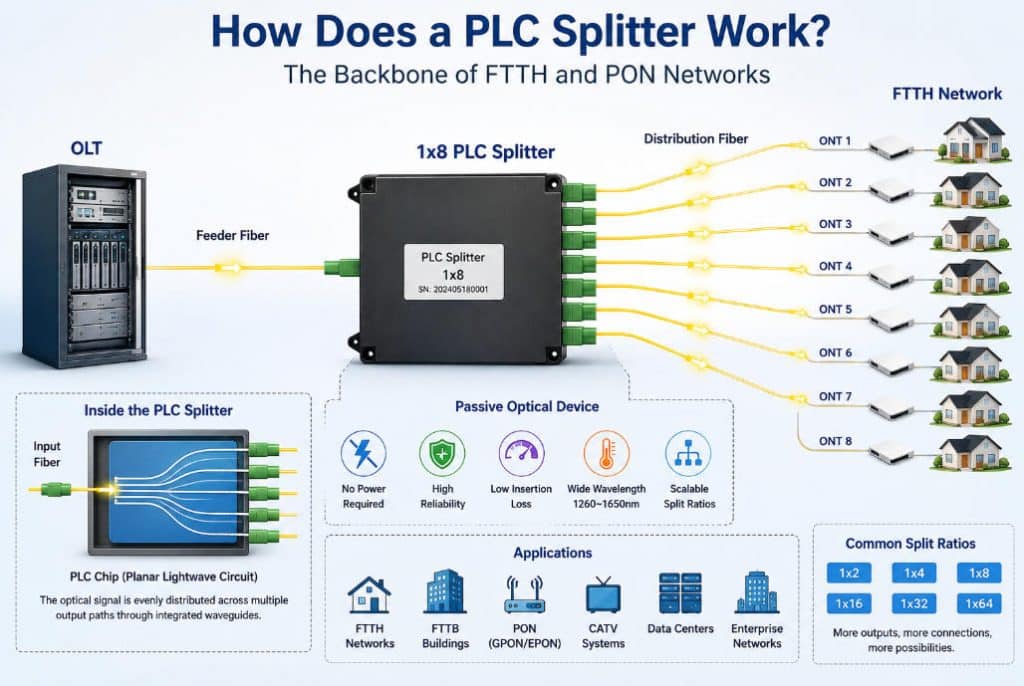
As Fiber-to-the-Home (FTTH), Fiber-to-the-Building (FTTB), and Passive Optical Networks (PON) continue to expand worldwide, the demand for reliable and efficient optical signal distribution has never been higher. One of the most critical components enabling these networks is the PLC splitter.
But how does a PLC splitter work? Why is it widely used in modern fiber optic networks? And how do network operators choose the right splitter for their applications?
In this guide, we’ll explain the working principle of PLC splitters, their advantages, applications, and selection considerations for telecom operators, ISPs, contractors, and fiber optic equipment distributors.
What Is a PLC Splitter?
A PLC (Planar Lightwave Circuit) splitter is a passive optical device that divides a single optical signal into multiple output signals with a predetermined splitting ratio.
Unlike traditional FBT (Fused Biconical Taper) splitters, PLC splitters use semiconductor manufacturing technology to create highly precise optical waveguides on a silica glass chip.
Because PLC splitters require no electrical power and contain no active components, they are highly reliable and ideal for large-scale optical distribution networks.
Common PLC splitter configurations include:
- 1×2 PLC Splitter
- 1×4 PLC Splitter
- 1×8 PLC Splitter
- 1×16 PLC Splitter
- 1×32 PLC Splitter
- 1×64 PLC Splitter
- 2×4 PLC Splitter
- 2×8 PLC Splitter
- 2×16 PLC Splitter
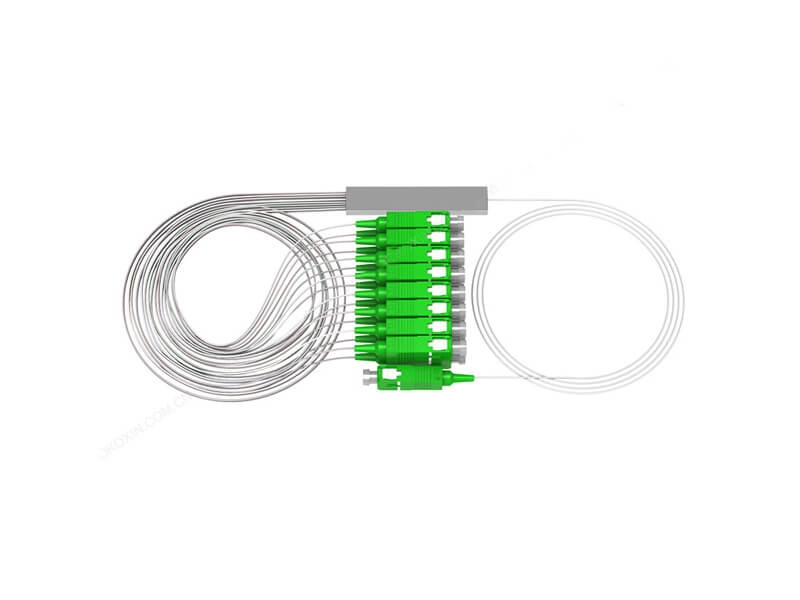
These splitters are commonly installed inside fiber distribution boxes, fiber optic patch panels, ODF systems, and outdoor cabinets.
How Does a PLC Splitter Work?
The working principle of a PLC splitter is based on optical waveguide technology.
When light enters the input fiber, it travels into the PLC chip through integrated optical waveguides.
The optical signal is then evenly distributed across multiple output channels through a carefully designed network of waveguides.
For example:
1×2 PLC Splitter
One optical input signal enters the splitter and is divided into two output signals.
Each output receives approximately 50% of the optical power.
1×4 PLC Splitter
One input signal is divided into four outputs.
Each output receives approximately 25% of the optical power.
1×8 PLC Splitter
One input signal is divided into eight outputs.
Each output receives approximately 12.5% of the optical power.
1×32 PLC Splitter
One input signal is divided into thirty-two outputs.
Each subscriber receives an equal portion of the original optical signal.
This allows a single Optical Line Terminal (OLT) port to serve multiple Optical Network Units (ONUs) or Optical Network Terminals (ONTs).
Main Components of a PLC Splitter
A PLC splitter typically consists of:
Optical Input Fiber
Receives the incoming optical signal from the network.
PLC Chip
The heart of the splitter.
Manufactured using silica-on-silicon technology, the chip contains microscopic optical waveguides responsible for signal splitting.
Fiber Array
Connects the PLC chip to input and output fibers.
Protective Housing
Depending on installation requirements, PLC splitters may be packaged as:
- Bare Fiber PLC Splitter
- Mini Tube PLC Splitter
- ABS Box PLC Splitter
- LGX PLC Splitter
- Rack Mounted PLC Splitter
Step-by-Step Signal Splitting Process
Step 1: Signal Reception
The optical signal arrives from the OLT through a feeder fiber.
Step 2: Light Coupling
The signal enters the PLC chip through the input waveguide.
Step 3: Waveguide Distribution
The integrated waveguide network divides the signal into multiple equal paths.
Step 4: Signal Output
The distributed signals exit through output fibers.
Step 5: Subscriber Connection
The output fibers connect to:
- Fiber distribution boxes
- Fiber patch panels
- Optical terminal boxes
- Drop cables
- Fiber optic patch cords
Finally, the signal reaches individual customers.
Why PLC Splitters Are Preferred in FTTH Networks
Uniform Signal Distribution
PLC splitters provide highly balanced optical power across all output ports.
This ensures stable performance for every subscriber.
Wide Wavelength Operation
PLC splitters support:
- 1260nm – 1650nm
Making them suitable for:
- GPON
- EPON
- XG-PON
- XGS-PON
- CATV Networks
Low Insertion Loss
High-quality PLC splitters minimize signal attenuation.
This improves overall network efficiency.
High Reliability
Since PLC splitters contain no moving parts or electronic components, they offer:
- Long service life
- Low maintenance requirements
- Excellent environmental stability
Compact Design
PLC splitters can be easily integrated into:
- Fiber optic distribution boxes
- Patch panels
- Outdoor cabinets
- ODF racks
PLC Splitter vs FBT Splitter
| Feature | PLC Splitter | FBT Splitter |
|---|---|---|
| Technology | Planar Waveguide | Fiber Fusion |
| Wavelength Range | Wide | Limited |
| Splitting Uniformity | Excellent | Moderate |
| Temperature Stability | High | Lower |
| Large Split Ratios | Excellent | Limited |
| FTTH Application | Ideal | Less Common |
Today, most modern FTTH deployments favor PLC splitter technology du
Common Applications of PLC Splitters
FTTH Networks
The most common application.
One OLT port can serve multiple residential subscribers.
Fiber-to-the-Building (FTTB)
Used in apartment complexes and commercial buildings.
Passive Optical Networks (PON)
PLC splitters form the foundation of GPON and EPON architectures.
CATV Systems
Enable optical signal distribution to multiple service areas.
Data Centers
Support efficient optical signal routing and distribution.
Enterprise Networks
Used for centralized fiber management and signal distribution.
How to Choose the Right PLC Splitter
When selecting a PLC splitter, consider the following factors:
Splitting Ratio
Choose according to subscriber quantity:
- 1×2
- 1×4
- 1×8
- 1×16
- 1×32
- 1×64
Connector Type
Common options include:
- SC/APC
- SC/UPC
- LC/APC
- LC/UPC
Package Type
Select based on installation environment:
- Mini Tube
- ABS Box
- LGX Module
- Rack Mount
Fiber Type
Typically:
- G652D Single Mode Fiber
- G657A1 Fiber
- G657A2 Fiber
Supplier Reliability
Choose an experienced PLC splitter manufacturer that provides:
- IEC compliance
- Telcordia testing
- Factory quality control
- Stable production capacity
- Custom OEM services
The Role of PLC Splitters in Future Fiber Networks
As broadband demand continues to increase, network operators are deploying higher-density PON technologies such as XGS-PON and 10G EPON.
PLC splitters remain a critical infrastructure component because they:
- Reduce deployment costs
- Simplify network architecture
- Enable efficient fiber sharing
- Support scalable subscriber growth
Their passive design and long-term reliability make them one of the most cost-effective solutions for modern optical access networks.
Conclusion
A PLC splitter is a passive optical device that divides one incoming optical signal into multiple outputs through integrated waveguide technology. It serves as the backbone of FTTH, FTTB, GPON, and other passive optical networks.
Compared with traditional FBT splitters, PLC splitters offer superior uniformity, wider wavelength support, higher reliability, and better scalability. Whether installed inside a fiber distribution box, patch panel, or outdoor cabinet, they play a vital role in delivering high-speed broadband services to millions of users worldwide.
If you are looking for a reliable PLC splitter supplier or manufacturer, choose a partner with proven production experience, strict quality control, and comprehensive fiber optic solutions to ensure long-term network performance